What is Barco CTRL, and how does KVM-over-IT differ from KVM-over-IP?
Author: Infra Technologies / Barco · Published:
This material is based on official information from Barco.
Barco CTRL is a platform for delivering video, audio and peripheral signals (keyboard, mouse, USB devices) from computers and servers to operator workstations over a shared network. It replaces conventional KVM extenders and matrix switchers, which are physically limited by port count and cable length.
What the platform consists of
A transmitter module sits at the source (computer, server, workstation) and digitises video and USB traffic. A receiver module sits at the operator desk, with the monitors, keyboard and mouse connected to it. Both modules connect to an ordinary network rather than dedicated point-to-point cabling, so an operator can switch to any source in the system with a single action, with no physical cable swapping.
How KVM-over-IT differs from KVM-over-IP
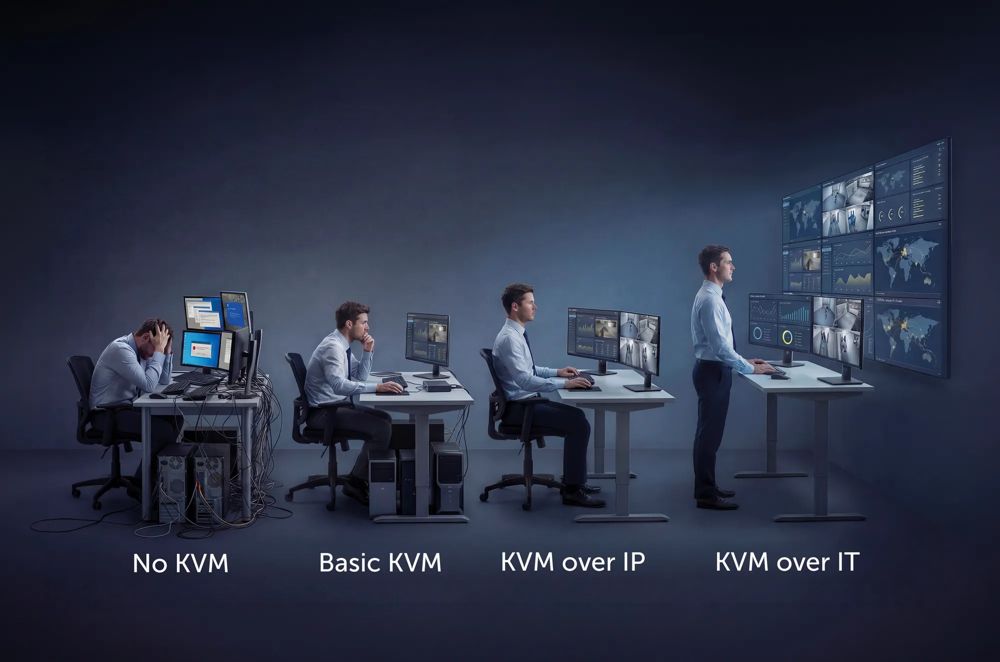
KVM-over-IP usually refers to sending signal over a network using compression and protocols originally built for remote access, where noticeable latency is acceptable. KVM-over-IT, which Barco CTRL is built on, is designed to run over standard IT infrastructure (switches, servers, ordinary network cabling) while keeping the latency and pixel-for-pixel image quality expected of a dedicated matrix system. The difference is not the fact of network transport itself, but that the architecture is engineered around control-room requirements: sub-frame latency, lossless image quality and predictable bandwidth.
What problem it solves at the operator's desk

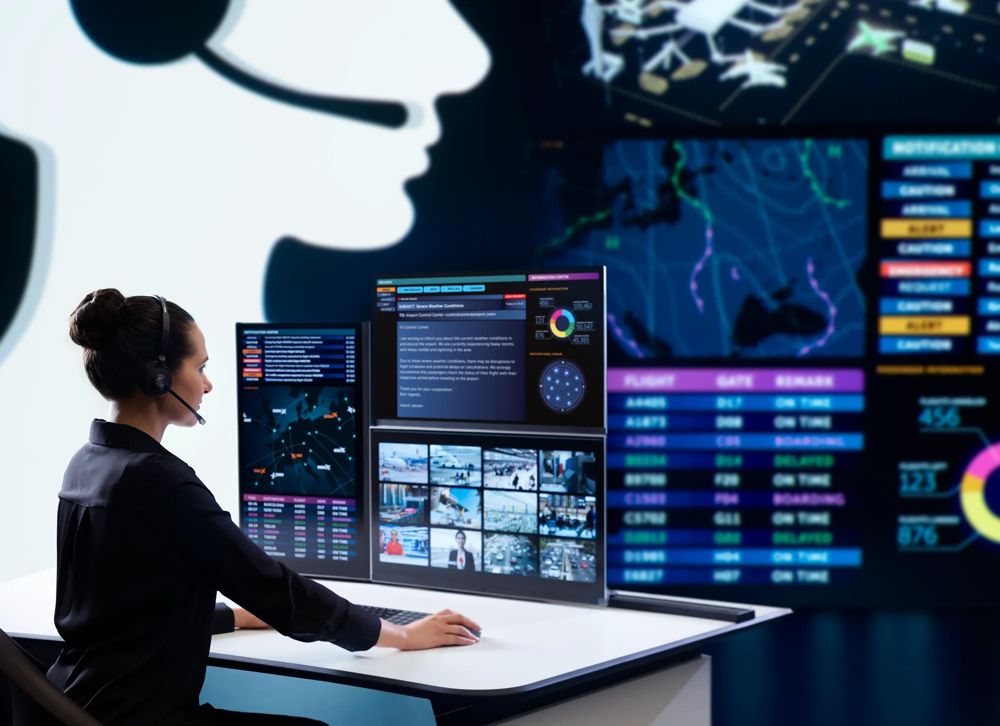
A control-room operator typically works with several sources at once: a SCADA system, video surveillance, mapping, email. Instead of a separate PC under the desk for each task, the compute moves to a server room and the desk keeps only a monitor, keyboard and mouse connected to the network module. That cuts heat and noise in the room, simplifies maintenance since engineers can service the server room without entering the control area, and makes workstation redundancy fast, an operator switches to a backup source in software if a machine fails.
Practical implications for a project
- Adding workstations scales without re-running cable trays.
- Any source can be routed to any workstation or video wall without a patch panel.
- Redundancy for sources and transport paths is built at the network level, not the cable level.
At Infra Technologies we design Barco CTRL-based KVM infrastructure for control rooms where what matters is not just the current workstation layout, but the ability to add sources and posts later without disruption.