

LCD or LED: which one to choose for a video wall?
Author: Infra Technologies / Barco · Published:
This material is based on official information from Barco.
A video wall is assembled from individual modules, and the technology you pick determines how it looks, how long it lasts, and what it costs to maintain. In practice the choice usually comes down to two options: narrow-bezel LCD panels (the classic video wall) and LED displays built from light-emitting cabinets.
LCD: a thin seam and a lower entry price

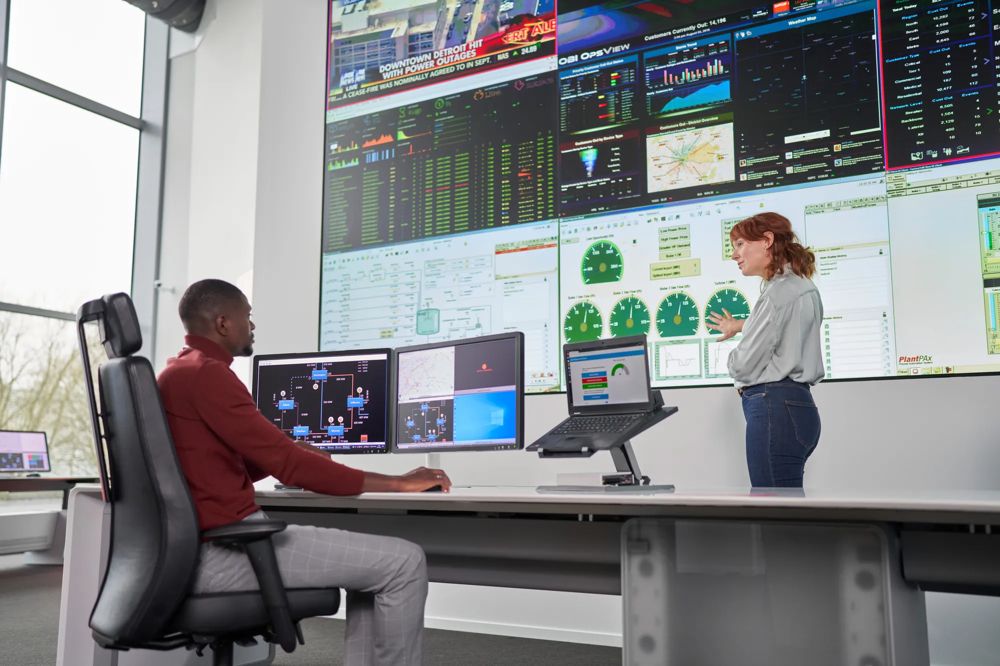
LCD video walls are built from 46 to 55 inch panels with a bezel-to-bezel gap starting around 0.88 mm. The technology is familiar to integrators, the panels are relatively inexpensive, and 4K resolution per module delivers sharp text and graphics at close range. That makes LCD a solid choice for control rooms, situation centres and meeting rooms where viewers sit a few metres away and work with tables, maps and video feeds at once.
The trade-offs are practical too. The seam between panels is still visible up close, backlight brightness fades unevenly over time, and replacing a single panel on older LCD walls means removing neighbouring modules (modern front-serviceable walls avoid this). The matrix has a fixed panel size, so reshaping the wall into a non-standard format is harder than with LED.
LED: a seamless image and shape flexibility

LED cabinets tile together without a visible seam, so the wall reads as one continuous surface from as close as 2-3 metres at the pixel pitch typical for indoor rooms, roughly 0.9 to 1.5 mm. LED is brighter, holds colour better under direct light, and lets you build a screen in almost any shape or aspect ratio, not just a rectangle made of standard diagonals. Modern cabinets are usually front-serviceable: a magnetically mounted service module comes off from the front in minutes without powering down its neighbours.
The trade-off is cost per square metre, which runs higher than LCD, and the fact that viewing from too close relative to the pixel pitch lets the eye resolve individual LEDs instead of a smooth image. LED also demands careful colour calibration between cabinets when a screen is built up in stages or from different production batches.
How to choose
- Small room, viewers sitting close, mostly text and tabular data: LCD is usually the better fit.
- Viewing distance of several metres, a seamless image, or a non-standard shape: LED becomes the natural choice.
- For a 24/7 control room, the technology choice matters less than brightness headroom, redundant signal sources and the ability to service the wall without taking it offline.
At Infra Technologies we match the technology to the task and the budget rather than pushing one answer for every project. On many sites a mix works best, for example LCD in the meeting rooms and LED in the control room of the same building.